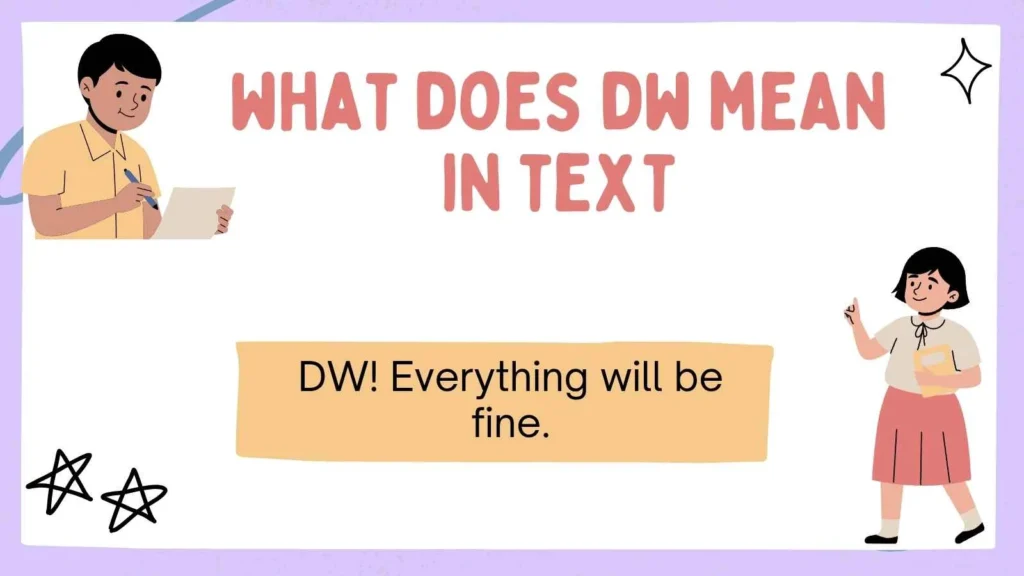
Have you ever received a message saying “DW, everything is okay” and wondered what it actually meant? You’re not alone.
Every day, millions of people use short forms while texting, chatting, and posting on social media. These abbreviations save time and make conversations feel quicker and more casual.
If you’re asking what does DW mean in text, you’ve come to the right place.
The abbreviation DW is one of the most common texting terms used across messaging apps like WhatsApp, Messenger, Instagram, Snapchat, TikTok, Discord, and even SMS.
While its primary meaning is easy to understand, it can sometimes have different meanings depending on the conversation.
What Does DW Mean in Text? 🤔
The most common meaning of DW in text is:
“Don’t Worry.” 😊
People use DW to comfort someone, reduce stress, or reassure another person that everything is fine. Instead of typing “Don’t worry”, many people simply write “DW” because it’s shorter and faster.
Quick Answer Table
| Term | Meaning | Tone | Common Use |
|---|---|---|---|
| DW | Don’t Worry | Friendly | Text messages |
| DW | Don’t Worry | Casual | Social media |
| DW | Don’t Worry | Relaxing | Online chats |
| DW | Don’t Worry | Supportive | Gaming chats |
Example Conversations
Friend: Sorry I’m running late.
You: DW! I’ll wait. 😊
Mom: Did you finish your homework?
Child: Yes, DW, it’s done.
Coworker: I think I made a mistake.
You: DW, we’ll fix it together.
In all of these examples, DW helps make the conversation feel calm and positive.
The Origin of DW in Texting 📖
Like many internet abbreviations, DW became popular because people wanted to communicate faster. During the early days of online chatting, texting had character limits, and mobile phones often had small keyboards. Typing fewer letters saved both time and effort.
As texting culture grew, abbreviations such as LOL, BRB, IDK, IMO, TBH, and DW became part of everyday digital language.
Today, DW is recognized worldwide and appears across many platforms.
Why People Prefer DW
- 📱 Faster than typing “Don’t worry”
- ⌨️ Saves typing time
- 😊 Sounds friendly
- 💬 Makes conversations casual
- 🌍 Understood by millions of internet users
Because of its positive meaning, DW has become one of the safest and most widely accepted texting abbreviations.
When Do People Use DW in Text? 💬
People usually send DW whenever they want someone to feel better or stop stressing.
Here are the most common situations.
When someone apologizes
Friend: Sorry I forgot.
You: DW! It happens.
When someone is nervous
Friend: I’m scared about tomorrow.
You: DW. You’ll do great!
When plans change
Friend: I can’t come today.
You: DW. Maybe next time.
When someone thanks you
Friend: Thanks for helping.
You: DW! Happy to help.
When fixing a problem
Coworker: I accidentally deleted the file.
Manager: DW. We have a backup.
Common Situations Table
| Situation | Example |
|---|---|
| Someone apologizes | DW, it’s okay. |
| Someone is stressed | DW, everything will work out. |
| Someone made a mistake | DW, everyone makes mistakes. |
| Plans changed | DW, we can reschedule. |
| Someone is worried | DW, I’ll handle it. |
How to Use DW Correctly in Conversations ✍️
Using DW is simple, but understanding the tone is important.
Most people use it in informal conversations with friends, classmates, family members, teammates, or online communities.
Good Examples
DW, I’ve got it.
✅ DW about the money.
DW, everything is under control.
✅ DW, you’ll be okay.
DW! It wasn’t your fault.
Less Appropriate Situations
While DW is friendly, it may sound too casual in formal situations.
For example:
Business proposal
Academic report
Official email
Legal documents
Instead, write:
- Don’t worry.
- No problem.
- Everything is okay.
- Rest assured.
Professional writing usually avoids texting abbreviations.
Tips for Using DW Naturally
- 😊 Use it with friends.
- 📱 Great for texting.
- 💬 Perfect for social media chats.
- 🎮 Popular in gaming communities.
- ❤️ Works best in casual conversations.
- ✨ Add emojis to sound warmer.
Different Meanings of DW Besides “Don’t Worry” 🌍
Although Don’t Worry is the most common meaning, DW can stand for other things depending on the context.
Understanding the conversation helps identify the correct meaning.
| DW Meaning | Where Used |
|---|---|
| Don’t Worry | Texting |
| Dear Wife | Family discussions |
| Data Warehouse | Technology |
| Dream World | Entertainment |
| Driving While | Informal writing |
| Digital Workspace | Business technology |
However, in everyday texting and social media, over 95% of the time, DW simply means Don’t Worry.
Example
Text: DW, I’ll call you later.
Meaning:
✅ Don’t worry, I’ll call you later.
Office Meeting
“Our DW stores customer information.”
Meaning:
✅ Data Warehouse
Family Chat
“My DW is cooking dinner.”
Meaning:
✅ Dear Wife
Context always determines the intended meaning.
What Does DW Mean on Social Media? 📲
Social media users love abbreviations because they make conversations quick and natural.
Across most platforms, DW still means Don’t Worry.
People often reply:
- DW ❤️
- DW, you’re amazing.
- DW, I understand.
Snapchat
Snapchat conversations move quickly.
Examples:
Friend: I forgot to reply.
You: DW 😊
TikTok
Comment sections frequently include:
- DW, you’re not alone.
- DW, it happens.
- DW, that’s normal.
Friends often comment:
“DW! Everything will be fine.”
Discord
Gamers regularly type:
“DW, we’ll win next round.”
Family and friends commonly use:
“DW, I’m on my way.”
Platform Comparison
| Platform | Meaning |
|---|---|
| Don’t Worry | |
| Snapchat | Don’t Worry |
| TikTok | Don’t Worry |
| Don’t Worry | |
| Discord | Don’t Worry |
| Don’t Worry |
Across nearly every major platform, DW carries the same reassuring meaning, making it one of the easiest abbreviations to understand.
DW vs Other Popular Texting Abbreviations 📱
The internet is full of short forms, and many people confuse DW with other common abbreviations. While they all make texting faster, each one has a different purpose.
Here’s a simple comparison to help you remember them.
| Abbreviation | Meaning | Main Purpose |
|---|---|---|
| DW | Don’t Worry | Reassure someone |
| LOL | Laugh Out Loud | Show laughter |
| BRB | Be Right Back | Leaving briefly |
| IDK | I Don’t Know | Express uncertainty |
| TBH | To Be Honest | Share an honest opinion |
| IMO | In My Opinion | Give a personal view |
| SMH | Shaking My Head | Show disappointment |
| GTG | Got To Go | End a conversation |
| TY | Thank You | Show gratitude |
| NP | No Problem | Respond politely |
Example Conversation
Friend: Sorry I’m late.
You: DW! 😊
Friend: That joke was funny.
You: LOL! 😂
Friend: What’s the answer?
You: IDK. 🤷
Knowing these abbreviations helps you understand online conversations more naturally.
DW Meaning in Relationships ❤️
In personal relationships, DW is often used to comfort, encourage, or reassure a partner. It creates a friendly and caring tone without requiring a long reply.
Common Examples
Partner: I hope I didn’t upset you.
Reply: DW ❤️ Everything is okay.
Partner: I’m worried about tomorrow.
Reply: DW, we’ll handle it together.
Partner: Sorry I couldn’t call.
Reply: DW 😊 I understand.
Why Couples Use DW
- ❤️ Shows understanding
- 😊 Reduces stress
- 💬 Keeps conversations warm
- 🤝 Builds trust
- 🌟 Makes replies feel supportive
Although it’s short, DW often carries a comforting message that helps conversations stay positive.
DW Meaning in Gaming and Online Communities 🎮
Gamers use abbreviations constantly because they need to communicate quickly during matches.
In gaming chats, DW almost always means Don’t Worry.
Gaming Examples
Teammate: Sorry, I missed that shot.
Reply: DW, we’ll get the next one.
Player: I think we might lose.
Reply: DW! Keep playing.
Friend: My internet disconnected.
Reply: DW, we’ll wait.
Why Gamers Use DW
- 🎮 Saves typing time
- ⚡ Quick communication
- 😊 Encourages teammates
- 🤝 Promotes teamwork
- 💬 Keeps the game positive
Whether you’re playing casual games or competitive matches, DW helps maintain a supportive atmosphere.
Common Mistakes People Make with DW ⚠️
Although DW is easy to understand, people sometimes use it incorrectly.
Here are the most common mistakes.
Using DW in Formal Emails
Avoid writing:
❌ DW, your payment has been received.
Instead write:
✅ Don’t worry, your payment has been received.
Assuming Everyone Knows It
Not everyone understands internet slang.
If you’re speaking with someone unfamiliar with texting abbreviations, writing the full phrase is often better.
Using DW During Serious Situations
Sometimes people need empathy more than a short abbreviation.
For example:
Someone shares difficult personal news.
Instead of:
❌ DW.
A better response might be:
✅ I’m sorry you’re going through this. I’m here for you.
Confusing DW with Other Meanings
Depending on the topic, DW may also mean:
- Dear Wife
- Data Warehouse
- Digital Workspace
- Dream World
Always consider the conversation before deciding its meaning.
Tips for Using DW Naturally 💡
If you want your messages to sound friendly and natural, these simple tips can help.
Best Practices
- 😊 Use DW in casual conversations.
- 💬 Pair it with kind words.
- ❤️ Add emojis for warmth.
- 📱 Use it with friends and family.
- 🎮 Great for gaming chats.
- 🌍 Remember that context matters.
Examples
DW, I’ve already finished it.
✅ DW 😊 I’ll help you.
DW, everything is fine.
✅ DW! See you tomorrow.
These replies sound natural because they match everyday texting style.
Real-Life Examples of DW in Text Conversations 💬
Seeing DW in real conversations makes it much easier to understand.
Example 1
Alex: Sorry I forgot your birthday.
Emma: DW! We can celebrate this weekend. 🎉
Example 2
John: I think I failed the test.
Mike: DW. You probably did better than you think.
Example 3
Sarah: I’m running 15 minutes late.
Emily: DW 😊 I’m still getting ready.
Example 4
Chris: I accidentally deleted the picture.
Lily: DW. I still have a copy.
Example 5
Tom: I can’t join tonight.
Jake: DW! We’ll play tomorrow.
These examples show how DW naturally fits into everyday conversations.
Why Texting Abbreviations Like DW Are So Popular 🌐
Modern communication moves fast. People want quick, simple conversations without typing long sentences.
That’s one reason abbreviations like DW have become part of everyday digital language.
Benefits of Using DW
- ⚡ Faster typing
- 📱 Shorter messages
- 😊 Friendly tone
- 💬 Easy to understand
- 🌍 Recognized worldwide
- 🤝 Makes conversations feel casual
Even though it’s only two letters, DW communicates reassurance in a simple and effective way.
FAQs:
What does DW mean in text?
DW most commonly means Don’t Worry. It’s used to reassure someone that everything is okay or that they don’t need to stress.
Is DW rude?
No. DW is generally considered friendly and polite when used in casual conversations. However, it may feel too informal in professional settings.
What does DW mean on Snapchat?
On Snapchat, DW almost always means Don’t Worry. Friends use it to comfort or reassure each other during chats.
Can DW have more than one meaning?
Yes. While Don’t Worry is the most common meaning in texting, DW can also stand for Dear Wife, Data Warehouse, Digital Workspace, or Dream World, depending on the context.
Should I use DW in professional emails?
It’s better not to. Professional emails usually sound clearer and more polished when you write Don’t worry instead of using the abbreviation.
Final Thoughts:
If you’ve been wondering what does DW mean in text, the answer is simple: in most conversations, DW stands for Don’t Worry.
It’s a short, friendly abbreviation used to reassure someone, reduce stress, or show support in casual chats.
While it can have other meanings in specific contexts, understanding the conversation usually makes its intended meaning clear.
As digital communication continues to evolve, learning common abbreviations like DW helps you read messages more confidently and respond naturally.
Whether you’re chatting with friends, family, classmates, or teammates, using DW appropriately can make your conversations feel more relaxed, positive, and engaging.

I am a dedicated SEO content writer and language enthusiast with a passion for making modern slang, text abbreviations, and internet terms easy to understand. I carefully research every topic using trusted sources and real-world usage to ensure each explanation is accurate, clear, and up to date. My goal is to help readers quickly understand confusing words, texting acronyms, and online expressions through simple English, practical examples, and easy-to-follow guides. Every article is written with a focus on quality, trustworthiness, and a great reader experience, so you can find reliable answers with confidence.