Have you ever received a message that mentioned SMS and wondered what it really means? You’re not alone.
Every day, billions of people send text messages around the world, yet many still ask about the SMS meaning in text and how it differs from other messaging methods like WhatsApp, Messenger, or iMessage.
Understanding modern texting terms is important because digital communication has become a part of daily life.
Whether you’re chatting with friends, confirming a doctor’s appointment, receiving banking alerts, or getting online shopping updates, you’ve probably interacted with SMS without even thinking about it.
The good news is that SMS is one of the easiest texting terms to understand. Once you know what it stands for, you’ll recognize it everywhere.
What Does SMS Mean in Text? 📲
The SMS meaning in text is Short Message Service.
It is the standard technology that allows mobile phones to send and receive short text messages without using an internet connection.
Unlike messaging apps that require Wi-Fi or mobile data, SMS works through your mobile carrier’s cellular network.
Quick Definition
| Term | Meaning |
|---|---|
| SMS | Short Message Service |
| Type | Mobile Text Messaging |
| Internet Required | ❌ No |
| Mobile Network Required | ✅ Yes |
| Maximum Traditional Length | 160 Characters |
In simple words:
SMS is the original way mobile phones send text messages.
Today, many people simply call an SMS a text message.
Easy Example
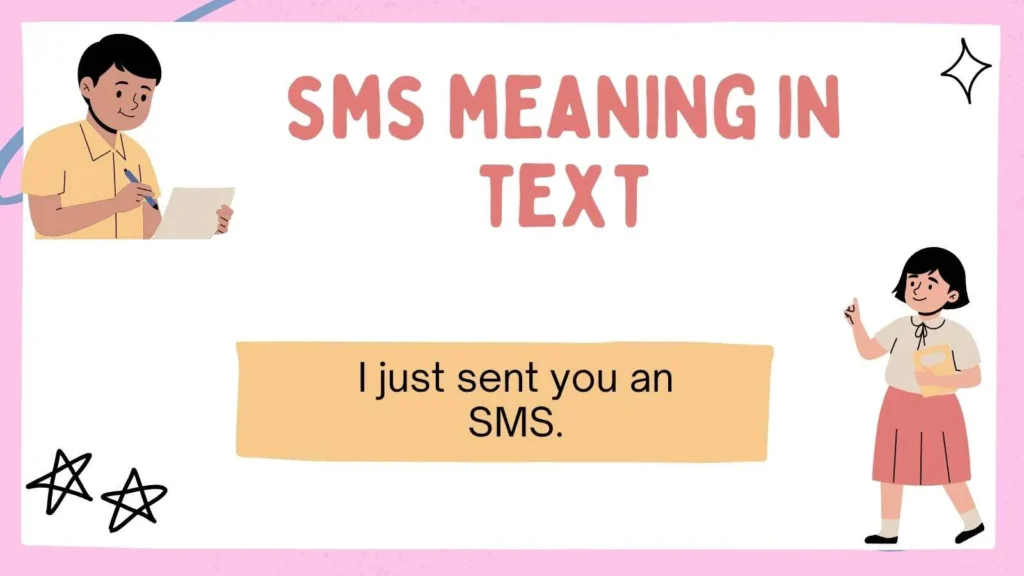
Friend: “I just sent you an SMS.”
Meaning:
“I just sent you a text message.”
Another example:
Bank: “You will receive an SMS verification code.”
This simply means you’ll receive a text message containing a security code.
The Full Form of SMS Explained 📖
Many people know the abbreviation but never learn what each word means.
Here’s the breakdown.
| Letter | Meaning |
|---|---|
| S | Short |
| M | Message |
| S | Service |
Let’s understand each word.
Short
Originally, SMS messages were limited to 160 characters, making every message short and simple.
Message
The service was designed specifically for sending written messages between mobile phones.
Service
SMS is a communication service provided through mobile networks around the world.
Put together, Short Message Service literally means a service used to deliver short written messages.
Although modern phones often combine several messages into one long conversation, the technology behind SMS still follows its original purpose.
The Origin of SMS 📜
Understanding where SMS came from helps explain why it remains important today.
The idea of SMS began during the development of digital mobile phone networks in the 1980s.
Engineers wanted a simple way for phones to exchange small pieces of text without making voice calls.
The first SMS message was sent in 1992.
The historic message simply read:
“Merry Christmas.” 🎄
That short message changed communication forever.
Soon after, mobile companies around the world adopted SMS technology.
Within a few years:
- 📱 Millions of people began texting.
- 🌍 SMS spread across nearly every country.
- 💬 Businesses started using SMS alerts.
- 🏦 Banks began sending security codes.
- 🛒 Companies sent order confirmations.
- ✈️ Airlines delivered flight updates.
- 🏥 Hospitals used appointment reminders.
Even though messaging apps became popular later, SMS never disappeared.
Today, it remains one of the world’s most reliable communication methods.
How SMS Works 📡
Many people assume every text message uses the internet.
That isn’t true.
SMS works very differently.
Here’s the basic process.
Step 1
You type a message.
Step 2
Your phone sends it to your mobile carrier.
Step 3
The carrier routes the message through its network.
Step 4
The recipient’s carrier receives it.
Step 5
The message appears on the recipient’s phone.
Unlike internet messaging apps:
- ✅ SMS works without Wi-Fi.
- ✅ SMS doesn’t require social media accounts.
- ✅ SMS doesn’t need messaging apps installed.
- ✅ SMS only needs a cellular connection.
This simplicity is one reason SMS remains trusted worldwide.
Why SMS Is Still Important Today 🌍
Some people think SMS is outdated because of apps like WhatsApp and Messenger.
In reality, SMS continues to play an important role.
Here are several reasons.
Almost Every Phone Supports SMS
Whether someone owns an expensive smartphone or a basic mobile phone, SMS usually works.
That makes it one of the most universal communication methods available.
No Internet Needed
Internet access isn’t always available.
SMS continues working even when Wi-Fi isn’t.
This makes it especially useful during:
- Emergencies
- Natural disasters
- Remote travel
- Poor internet coverage
Trusted for Verification
Many online services use SMS to verify identities.
Examples include:
- Banking logins
- Email verification
- Shopping accounts
- Government services
- Healthcare portals
These verification codes help improve account security.
Business Communication
Companies use SMS because customers usually read text messages quickly.
Businesses often send:
- 📦 Delivery updates
- 🎁 Promotional offers
- 💳 Payment reminders
- 📅 Appointment confirmations
- 🔐 Security alerts
- 🎟 Event tickets
SMS vs Text Message: Is There a Difference? 🤔
One of the biggest questions people ask is whether SMS and text message mean the same thing.
The short answer is:
Usually, yes.
Most people use both terms interchangeably.
However, there is a small technical difference.
| SMS | Text Message |
|---|---|
| Official technology | General everyday term |
| Uses cellular network | Can include SMS, MMS, and other messaging systems |
| No internet needed | May use internet depending on platform |
For everyday conversations:
“I’m sending you an SMS.”
and
“I’m sending you a text.”
mean exactly the same thing.
SMS vs MMS: Understanding the Difference 🖼️
People often confuse SMS with MMS.
Although both involve mobile messaging, they serve different purposes.
| Feature | SMS | MMS |
|---|---|---|
| Text Only | ✅ Yes | ✅ Yes |
| Photos | ❌ No | ✅ Yes |
| Videos | ❌ No | ✅ Yes |
| Audio | ❌ No | ✅ Yes |
| GIFs | ❌ No | ✅ Yes |
| Internet Required | Usually No | Depends on carrier |
SMS Example
“See you at 7 PM.”
MMS Example
A birthday message that includes:
- 🎂 Photo
- 🎉 GIF
- 🎈 Stickers
- 🎥 Short video
If your message contains only plain text, it is generally sent as an SMS.
If it includes media files, it may be sent as an MMS.
Common Examples of SMS in Everyday Life 💬
You probably receive SMS messages more often than you realize.
Here are some common examples.
Personal Messages
- “I’m outside.”
- “Call me when you’re free.”
- “Happy Birthday!”
- “See you tomorrow.”
Banking Messages
- Your OTP is 428913.
- Your payment was successful.
- Your account balance has been updated.
Shopping Updates
- Your package has shipped.
- Your order has been delivered.
- Your refund has been processed.
Healthcare Notifications
- Appointment reminder.
- Prescription ready for pickup.
- Health check reminder.
Travel Alerts
- Flight delayed.
- Boarding gate changed.
- Train arriving shortly.
These are all examples of SMS messages that people receive every day.
Common Places You’ll See SMS Used 📲
Even if you don’t send many text messages, you’ll likely encounter SMS in different situations.
Some of the most common places include:
- 📱 Mobile phone settings
- 🏦 Banking apps
- 🛒 Online shopping checkouts
- 💻 Account verification pages
- 🏥 Hospital appointment systems
- ✈️ Airline booking confirmations
- 🚚 Delivery tracking services
- 🎟 Event ticket confirmations
- 📢 Emergency public alerts
- 🔒 Two-factor authentication (2FA)
Whenever a website says, “We’ll send an SMS code,” it simply means you’ll receive a regular text message with a verification code.
SMS in Personal, Professional, and Business Communication 💼📱
The SMS meaning in text goes far beyond casual conversations. Today, SMS is used in almost every part of life because it is fast, reliable, and easy to access.
Personal Communication
People use SMS every day to stay connected with family and friends.
Examples include:
- ❤️ “Happy Anniversary!”
- 🎂 “Happy Birthday!”
- 📍 “I’m here.”
- 🚗 “Running 10 minutes late.”
- 📞 “Call me when you’re free.”
These short messages help people communicate quickly without needing an internet connection.
Professional Communication
Many workplaces also rely on SMS.
Employees may receive messages about:
- Meeting reminders
- Work schedule changes
- Interview confirmations
- Shift updates
- Emergency notices
Because SMS reaches almost every mobile phone, it is a dependable way to share important information.
Business Communication
Businesses use SMS to improve customer service and engagement.
Common business SMS messages include:
- 📦 Shipping confirmations
- 💳 Payment reminders
- 🛍️ Order updates
- 🎁 Promotional offers
- 🔐 Security verification codes
- 📅 Appointment reminders
Customers often check SMS within minutes, making it one of the most effective communication channels.
Common SMS Examples in Real Conversations 💬
Understanding the SMS meaning in text becomes much easier when you see it used in real-life situations.
Example 1
Emma: Did you get my SMS?
Noah: Yes, I just replied.
Meaning: Emma is asking whether Noah received her text message.
Example 2
Bank Message
Your verification code is 582941.
Do not share this code with anyone.
Example 3
Doctor’s Office
Reminder: Your appointment is tomorrow at 2:30 PM.
Reply YES to confirm.
Example 4
Online Store
Your package has been shipped.
Estimated delivery: Tuesday.
Example 5
School Notice
School will remain closed tomorrow due to severe weather.
These examples show that SMS is useful for both personal and official communication.
Common Misunderstandings About SMS ❌
Although SMS has existed for many years, several myths still confuse users.
Myth 1: SMS Needs the Internet
Truth: SMS uses your mobile carrier’s network, not Wi-Fi.
Myth 2: SMS Is the Same as WhatsApp
Truth: WhatsApp requires an internet connection, while SMS does not.
Myth 3: SMS Is No Longer Used
Truth: Millions of SMS messages are still sent every day for banking, healthcare, deliveries, security, and business communication.
Myth 4: SMS Can Only Be Used on Smartphones
Truth: Basic mobile phones also support SMS.
Myth 5: SMS Is Only for Personal Chats
Truth: Governments, hospitals, airlines, schools, and businesses all rely on SMS for important updates.
Benefits of Using SMS ✅
There are many reasons why SMS continues to be one of the world’s most trusted messaging methods.
Fast Delivery ⚡
Most SMS messages arrive within seconds.
Wide Compatibility 🌍
Almost every mobile phone supports SMS.
No Internet Required 📶
You only need a mobile signal.
Reliable Communication 🔒
SMS often works in areas where internet service is weak.
Great for Security 🔐
Many websites send one-time passwords (OTPs) through SMS.
Easy to Use 😊
No special app or account is required.
High Read Rates 👀
People usually read text messages shortly after receiving them.
SMS Compared With Popular Messaging Apps 📊
The table below highlights the main differences.
| Feature | SMS | Messenger | iMessage | |
|---|---|---|---|---|
| Internet Required | ❌ No | ✅ Yes | ✅ Yes | ✅ Usually |
| Mobile Number Needed | ✅ Yes | ✅ Yes | ❌ No | ✅ Yes |
| Photos & Videos | ❌ SMS Only | ✅ Yes | ✅ Yes | ✅ Yes |
| Works on Basic Phones | ✅ Yes | ❌ No | ❌ No | ❌ No |
| Verification Codes | ✅ Common | ❌ Rare | ❌ Rare | ❌ Rare |
This comparison shows why SMS still plays a unique role in modern communication.
Tips for Using SMS Safely 🔐
Because SMS often contains sensitive information, following a few safety tips is important.
Never Share Verification Codes
Banks and trusted companies will never ask you to share your OTP.
Watch for Scam Messages
Ignore messages that:
- Ask for passwords
- Request payment unexpectedly
- Promise unrealistic prizes
- Create unnecessary urgency
Verify Unknown Numbers
If you receive an unexpected SMS, confirm its authenticity before responding.
Avoid Clicking Suspicious Links
Some fraudulent messages contain harmful links.
Only interact with links from trusted organizations.
Protect Your Personal Information
Never send sensitive information such as:
- Bank PINs
- Passwords
- Credit card details
- Identity numbers
Good SMS habits help keep your personal information secure.
Related Texting Terms You Should Know 📚
If you’re learning the SMS meaning in text, you’ll also come across other popular texting terms.
| Term | Meaning |
|---|---|
| SMS | Short Message Service |
| MMS | Multimedia Messaging Service |
| OTP | One-Time Password |
| 2FA | Two-Factor Authentication |
| DM | Direct Message |
| PM | Private Message |
| IM | Instant Message |
| RCS | Rich Communication Services |
Knowing these terms makes modern digital communication much easier to understand.
FAQs:
What does SMS mean in text?
SMS stands for Short Message Service. It is the standard technology used to send plain text messages between mobile phones through a cellular network.
Is SMS the same as a text message?
In most everyday conversations, yes. People commonly use SMS and text message to mean the same thing, although “text message” is a broader term that can also include other messaging technologies.
Does SMS require an internet connection?
No. SMS works through your mobile carrier’s network and does not require Wi-Fi or mobile data.
Why do banks use SMS?
Banks use SMS to send security alerts, transaction notifications, and one-time verification codes because SMS is fast, reliable, and supported by nearly every mobile phone.
Can I send photos through SMS?
Traditional SMS supports only plain text. If you send photos, videos, or other media, your phone usually switches to MMS or another supported messaging service.
Final Thoughts:
Understanding the SMS meaning in text is more useful than ever in today’s digital world.
Although messaging apps have become increasingly popular, SMS remains one of the most trusted and widely used communication methods.
From personal conversations and appointment reminders to banking alerts and security verification codes, SMS continues to play an essential role in everyday life.
Now that you know what SMS means, its full form, origin, how it works, and how it differs from other messaging services, you’ll be able to recognize and use it with confidence in any situation.
Whether you’re sending a quick message to a friend or receiving an important notification from your bank, SMS remains a simple, reliable, and effective way to stay connected.

I am a dedicated SEO content writer and language enthusiast with a passion for making modern slang, text abbreviations, and internet terms easy to understand. I carefully research every topic using trusted sources and real-world usage to ensure each explanation is accurate, clear, and up to date. My goal is to help readers quickly understand confusing words, texting acronyms, and online expressions through simple English, practical examples, and easy-to-follow guides. Every article is written with a focus on quality, trustworthiness, and a great reader experience, so you can find reliable answers with confidence.