Have you ever received a message saying “ion know” or “ion like that” and wondered what it actually means? You’re not alone.
Online conversations move fast, and people often shorten words to save time. One of the most common slang terms you’ll see today is ion.
The ion meaning in text has become increasingly popular on platforms like TikTok, Snapchat, Instagram, X, Discord, and everyday text messages.
While it may look confusing at first, it’s actually very simple once you understand how people use it.
In this guide, you’ll learn everything about ion meaning in text, including its origin, how it became popular, when to use it, examples, common mistakes, and much more.
By the end, you’ll be able to recognize and use this slang naturally in your own conversations. 😊
What Does Ion Mean in Text? 🤔
Quick Answer
Ion is internet slang that usually means “I don’t.”
People simply remove the apostrophe and combine the words I and don’t into one short word:
- I don’t know → Ion know
- I don’t care → Ion care
- I don’t want to → Ion wanna
- I don’t think so → Ion think so
This makes texting quicker and feels more casual.
Featured Snippet Answer
| Question | Answer |
|---|---|
| What does ion mean in text? | Ion usually means “I don’t.” It is a popular internet slang abbreviation used in texting and social media to make conversations shorter and more casual. |
Unlike many internet abbreviations, ion isn’t formed from the first letters of several words. Instead, it’s simply a faster way to write how “I don’t” sounds when spoken quickly.
For example:
Friend: Wanna go out tonight?
You: Ion know yet.
Here, ion know clearly means “I don’t know.”
Another example:
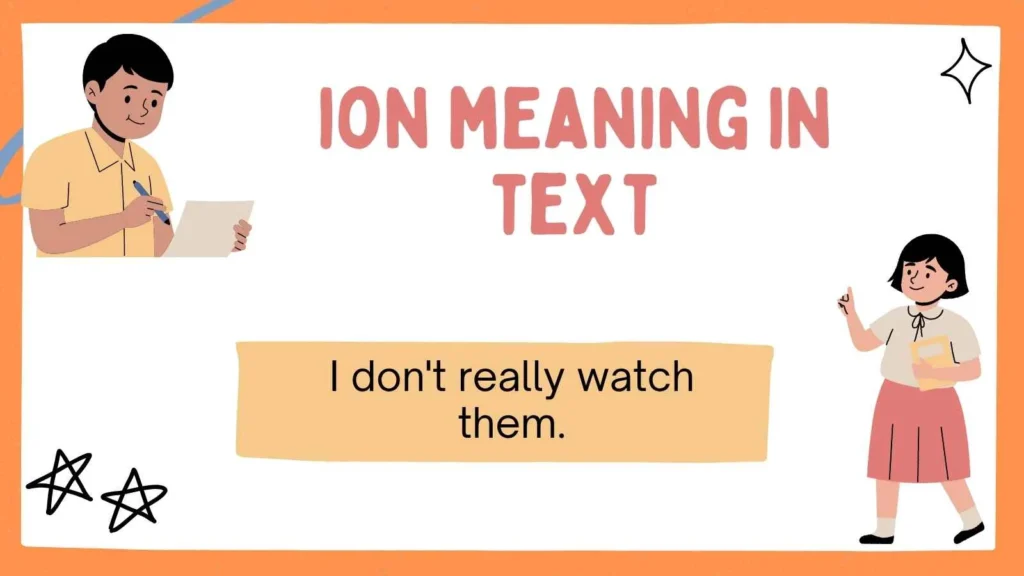
Friend: Do you like horror movies?
You: Ion really watch them.
Again, the meaning is “I don’t really watch them.”
Because the meaning stays consistent in most conversations, readers usually understand it immediately.
The Origin of Ion in Texting 🌎
Like many internet slang words, ion didn’t suddenly appear overnight. It developed naturally from everyday speech.
When people speak quickly, especially in casual conversations, “I don’t” often sounds like:
- I’un
- Ah-don
- Ion
Eventually, social media users began typing it exactly how they pronounced it.
The slang gained popularity through:
- 📱 Text messaging
- 🎵 Hip-hop culture
- 🎥 Short-form videos
- 🎮 Online gaming chats
- 💬 Group conversations
- 📢 Viral memes
As platforms became more conversational, people started writing messages exactly as they sounded instead of using formal grammar.
For example:
Instead of writing:
I don’t think that’s true.
Many users simply typed:
Ion think that’s true.
This style felt faster, more relaxed, and easier to type.
Today, millions of users write ion every day without even thinking about it.
Why It Became So Popular
Several reasons explain why ion meaning in text spread so quickly:
*✅ Saves typing time
✅ Sounds natural
*✅ Matches spoken English
✅ Fits casual conversations
*✅ Popular among younger users
✅ Frequently seen in memes and social media comments
Like many internet slang expressions, its popularity grew because people copied what they saw others writing.
How Is Ion Used in Text Messages? 💬
Understanding ion meaning in text becomes much easier once you see it in real conversations.
In almost every situation, simply replace ion with I don’t, and the sentence makes perfect sense.
Everyday Examples
| Text Message | Meaning |
|---|---|
| Ion know. | I don’t know. |
| Ion care. | I don’t care. |
| Ion think so. | I don’t think so. |
| Ion wanna go. | I don’t want to go. |
| Ion remember. | I don’t remember. |
| Ion believe him. | I don’t believe him. |
| Ion have time. | I don’t have time. |
| Ion see anything. | I don’t see anything. |
These examples show that ion almost always appears at the beginning of a sentence because it replaces I don’t.
Example Conversations
Conversation 1
Alex: Are you coming tonight?
Sam: Ion know yet.
Conversation 2
Emma: Did you finish the homework?
Ryan: Ion even started.
Conversation 3
Chris: Do you like spicy food?
Mia: Ion really eat spicy food.
Conversation 4
Jake: Are you busy?
Lily: Ion think so.
Conversation 5
Noah: Can you help me tomorrow?
Olivia: Ion have plans, so sure.
These examples sound completely natural in casual texting.
Common Phrases Using Ion
You’ll often see these phrases online:
- Ion know
- Ion care
- Ion think
- Ion wanna
- Ion remember
- Ion see
- Ion understand
- Ion believe
- Ion got it
- Ion feel like it
Most users instantly recognize these expressions because they’re widely used across social media.
When Should You Use Ion?
Using ion depends on your audience.
It works well in:
- 😊 Casual texting
- 📱 Snapchat chats
- 🎵 TikTok comments
- 📸 Instagram DMs
- 🎮 Gaming chats
- 💬 Friends’ group chats
- 😂 Funny memes
Avoid using it in:
- 📄 School essays
- 💼 Job applications
- 📧 Professional emails
- 📑 Business reports
- 🎓 Academic writing
- 📝 Official documents
Remember, ion is informal slang. While it’s perfect for chatting with friends, it’s not appropriate in professional or formal communication.
Ion Meaning Across Social Media Platforms 📱🌐
The ion meaning in text stays almost the same across most social media platforms. In nearly every case, ion means “I don’t.” However, the style and tone of the conversation can change depending on where you see it.
Each platform has its own way of communicating. Some users keep messages short, while others use slang more often. Understanding these differences helps you read messages correctly and avoid confusion.
Here’s how ion is commonly used on popular platforms.
Snapchat 👻
Snapchat is built around quick conversations, disappearing messages, and casual chats. Because users often type fast, slang like ion appears frequently.
Examples:
- Ion know where he went.
- Ion wanna lose my streak.
- Ion think she’s online.
- Ion remember sending that.
- Ion got your message.
Snapchat users usually understand ion immediately because it’s a familiar part of texting culture.
TikTok 🎵
TikTok comments are short, funny, and conversational. You’ll often find ion in comment sections, video captions, and replies.
Examples:
- Ion expected that ending.
- Ion can stop watching this.
- Ion blame you.
- Ion think anyone saw that coming.
- Ion knew it would go viral.
Many creators use casual language to sound relatable, making ion a common choice.
Instagram 📸
Instagram users frequently use ion in direct messages, Stories, and comments.
Examples:
- Ion even noticed.
- Ion like that outfit.
- Ion have anything to post today.
- Ion think this filter works.
- Ion forgot to reply.
Because Instagram conversations are usually informal, slang fits naturally.
X (Formerly Twitter) 🐦
Character limits encourage short writing, making abbreviations especially useful.
Examples:
- Ion agree.
- Ion think that’s true.
- Ion watching that game.
- Ion believe the news.
- Ion understand the hype.
Discord 🎮
Gaming communities often communicate quickly during live conversations.
Examples:
- Ion hear anything.
- Ion got enough coins.
- Ion joining tonight.
- Ion finished the mission.
- Ion see the enemy.
Facebook 💙
Although Facebook users generally write longer posts, ion still appears in comments and Messenger chats.
Examples:
- Ion know what happened.
- Ion think that’s fair.
- Ion remember that day.
- Ion agree with everyone.
- Ion have any idea.
Does the Meaning Change?
Not really.
Across nearly every social platform, ion still means:
✔️ I don’t
Only the writing style changes depending on the community.
Ion vs. Other Popular Texting Slang 📖
Many internet abbreviations look similar, but they have completely different meanings. Understanding the difference prevents misunderstandings.
Here’s a comparison of ion with other popular texting slang.
| Slang | Meaning | Example |
|---|---|---|
| Ion | I don’t | Ion know. |
| IDK | I don’t know | IDK what happened. |
| IMO | In my opinion | IMO that’s better. |
| TBH | To be honest | TBH I liked it. |
| FR | For real | That’s crazy FR. |
| NGL | Not gonna lie | NGL that’s funny. |
| SMH | Shaking my head | SMH that’s disappointing. |
| BTW | By the way | BTW thanks again. |
| IKR | I know, right? | IKR that’s amazing. |
| LMK | Let me know | LMK tomorrow. |
Notice that ion is different because it isn’t an acronym. Instead, it’s a shortened way of writing how “I don’t” sounds in everyday speech.
Ion vs. IDK
People often confuse these two.
Ion means:
I don’t
IDK means:
I don’t know
Examples:
- Ion care.
- Ion believe him.
- IDK what happened.
- IDK where she is.
Since IDK already includes the word know, it cannot replace every use of ion.
Ion vs. ION (Science)
Another common misunderstanding comes from science classes.
In chemistry:
Ion refers to an atom or molecule that carries an electrical charge.
Example:
- Sodium becomes a positive ion.
- Chloride becomes a negative ion.
In texting:
Ion means:
I don’t
The context makes the meaning obvious.
| Context | Meaning |
|---|---|
| Science | Electrically charged particle |
| Text messages | I don’t |
This is why reading the whole sentence is important.
Is Ion an Acronym?
No.
Unlike abbreviations such as:
- LOL
- BRB
- IDK
- OMG
Ion is not made from the first letters of several words.
Instead, it’s a phonetic spelling. People simply write the way “I don’t” sounds during casual speech.
That small difference makes ion unique among internet slang terms.
Common Examples of Ion in Real Conversations 💬
The best way to understand the ion meaning in text is by seeing it used naturally.
Below are several realistic conversations that show how people use ion every day.
Example 1
Emma: Are you free tonight?
Jake: Ion know yet.
Meaning:
“I don’t know yet.”
Example 2
Lily: Did you watch the movie?
Ben: Ion have time.
Meaning:
“I don’t have time.”
Example 3
Chris: Do you trust him?
Mia: Ion think so.
Meaning:
“I don’t think so.”
Example 4
Ryan: Are you hungry?
Sophia: Ion feel like eating.
Meaning:
“I don’t feel like eating.”
Example 5
Alex: Did she call you?
Noah: Ion remember.
Meaning:
“I don’t remember.”
Example 6
Friend: Wanna play later?
You: Ion think I’ll be home.
Meaning:
“I don’t think I’ll be home.”
Example 7
Friend: Did you buy it?
You: Ion got enough money.
Meaning:
“I don’t have enough money.”
Example 8
Friend: Do you believe the rumor?
You: Ion believe everything online.
Meaning:
“I don’t believe everything online.”
Example 9
Friend: Are you excited?
You: Ion even know what’s happening.
Meaning:
“I don’t even know what’s happening.”
Example 10
Friend: Why didn’t you answer?
You: Ion see your message.
Meaning:
“I didn’t see your message.”
Although the wording may vary slightly, readers naturally understand the intended meaning from the conversation.
Everyday Sentences Using Ion
Here are more examples you might see online:
- Ion understand.
- Ion wanna argue.
- Ion like coffee.
- Ion care anymore.
- Ion believe that story.
- Ion remember her name.
- Ion got the answer.
- Ion think you’re wrong.
- Ion need anything.
- Ion have enough time.
- Ion wanna leave early.
- Ion see the problem.
- Ion know the password.
- Ion heard anything.
- Ion finished my work.
Reading these examples repeatedly helps you recognize ion instantly whenever it appears in text messages or social media conversations.
Common Mistakes People Make About Ion ❌
The ion meaning in text is simple once you know it, but many people misunderstand it the first time they see it. Since ion has another meaning in science and isn’t a traditional abbreviation, confusion is common.
Learning these mistakes can help you interpret messages correctly and use the slang naturally.
Mistake 1: Thinking Ion Always Refers to Science
One of the biggest misunderstandings is assuming every use of ion relates to chemistry.
For example:
Text Message:
Ion know what happened.
This sentence clearly doesn’t refer to a charged particle. Instead, it means:
I don’t know what happened.
Always read the surrounding words before deciding what ion means.
Mistake 2: Believing Ion Is an Acronym
Many people think ion stands for several words, similar to LOL or BRB.
That’s incorrect.
Ion is not an acronym. It’s simply a phonetic spelling of “I don’t.”
People write it the way they naturally pronounce it in casual speech.
Mistake 3: Using Ion in Formal Writing
Another common mistake is using ion where professional language is expected.
For example:
❌ Incorrect
Ion agree with your proposal.
✅ Better
I don’t agree with your proposal.
Professional writing should use complete words and proper grammar.
Mistake 4: Assuming Everyone Understands It
Although ion is popular, not everyone is familiar with internet slang.
Older readers, teachers, employers, or international audiences may not recognize it.
If you’re unsure whether someone understands texting slang, it’s usually better to write I don’t instead.
Mistake 5: Using Ion in Every Sentence
Because ion is trendy, some people overuse it.
Example:
Repeating slang too often can make your writing feel unnatural.
Using a mix of casual and standard language keeps conversations easy to read.
Quick Summary of Common Mistakes
| Mistake | Correct Understanding |
|---|---|
| Thinking it’s scientific | Usually means I don’t in texting |
| Treating it like an acronym | It’s a phonetic spelling |
| Using it in business writing | Use I don’t instead |
| Assuming everyone knows it | Some readers may not |
| Overusing it | Balance slang with normal English |
Avoiding these mistakes helps you communicate more clearly.
When Should You Use Ion—and When Should You Avoid It? 📝
Knowing the ion meaning in text is only part of the story. It’s equally important to know when it’s appropriate to use it.
Because ion is informal slang, it works well in relaxed conversations but not in every situation.
Great Times to Use Ion
You can confidently use ion when chatting casually with people who understand internet slang.
Some good situations include:
- 💬 Texting friends
- 📱 Snapchat conversations
- 📸 Instagram direct messages
- 🎵 TikTok comments
- 🎮 Gaming chats
- 😂 Meme pages
- 👥 Group chats
- 🗨️ Casual online discussions
Examples:
- Ion know what’s going on.
- Ion wanna leave yet.
- Ion think that’s true.
- Ion remember his name.
These conversations are informal, so slang feels natural.
Situations Where You Should Avoid Ion
Professional communication calls for complete words and proper grammar.
Avoid using ion in:
- 📧 Business emails
- 📄 Job applications
- 📚 School assignments
- 🎓 Research papers
- 📝 Formal presentations
- 📑 Official reports
- 💼 Workplace communication
- 📜 Legal documents
Instead, write the full phrase:
I don’t
Doing so creates a more polished and professional impression.
Think About Your Audience
Before using ion, ask yourself:
- Will this person understand internet slang?
- Is the conversation casual?
- Am I speaking professionally?
- Would full English sound better here?
If the answer points toward a formal setting, skip the slang.
Quick Decision Guide
| Situation | Use Ion? |
|---|---|
| Friends texting | ✅ Yes |
| Family chat | ✅ Usually |
| Snapchat | ✅ Yes |
| TikTok | ✅ Yes |
| Instagram DMs | ✅ Yes |
| Gaming | ✅ Yes |
| School essay | ❌ No |
| Work email | ❌ No |
| Job interview | ❌ No |
| Business proposal | ❌ No |
Choosing the right style helps your message sound appropriate for the situation.
Related Slang Words You Should Know 💡
If you’ve learned the ion meaning in text, you’ll probably come across many other internet slang terms in everyday conversations.
Knowing these expressions makes online communication easier and helps you understand messages without stopping to search every unfamiliar word.
Popular Texting Slang
| Slang | Meaning | Example |
|---|---|---|
| IDK | I don’t know | IDK what happened. |
| TBH | To be honest | TBH I liked it. |
| IMO | In my opinion | IMO that’s the best choice. |
| NGL | Not gonna lie | NGL I’m surprised. |
| FR | For real | That’s funny FR. |
| SMH | Shaking my head | SMH people never listen. |
| BTW | By the way | BTW thanks again. |
| LMK | Let me know | LMK tomorrow. |
| IKR | I know, right? | IKR that’s amazing! |
| BRB | Be right back | BRB dinner time. |
| AFK | Away from keyboard | AFK for five minutes. |
| OMG | Oh my gosh | OMG that’s incredible. |
Why Slang Keeps Changing
Internet language evolves quickly.
Every year, new slang appears because people:
- Want shorter messages
- Follow online trends
- Copy creators and influencers
- Join online communities
- Create inside jokes
- Express emotions more casually
Some slang disappears after a few months, while others become part of everyday communication.
Ion has remained popular because it’s easy to understand and naturally replaces “I don’t.”
Tips for Learning New Slang
If you frequently use social media, these habits can help you stay updated:
- 📖 Read comments regularly.
- 📱 Watch how creators write captions.
- 💬 Pay attention to group chats.
- 🎮 Join online communities.
- ❓ Look up unfamiliar words.
- 🧠 Learn slang through context instead of memorizing lists.
Over time, you’ll recognize popular expressions without thinking twice.
Final Tip Before Moving On
Remember this simple trick:
Whenever you see ion in a text message, mentally replace it with:
I don’t
If the sentence still makes sense, you’ve almost certainly understood it correctly.
This small habit helps you decode slang quickly and confidently, even if it’s your first time seeing it.
FAQs:
What does ion mean in text messages?
The ion meaning in text is usually “I don’t.” People use it as informal internet slang to make messages shorter and faster. For example, “Ion know” means “I don’t know.”
Is ion an abbreviation or an acronym?
No. Ion is not an acronym like LOL or IDK. Instead, it is a phonetic spelling of the phrase “I don’t.” It reflects how many people naturally pronounce those words in casual speech.
Does ion always mean “I don’t”?
In texting and social media, yes, it almost always means “I don’t.” However, in science, ion has a completely different meaning. It refers to an atom or molecule with an electrical charge. Always use the surrounding context to understand which meaning is intended.
Is it okay to use ion in professional writing?
No. Since ion is informal slang, it should be avoided in professional settings such as:
- Business emails
- Job applications
- Academic assignments
- Official reports
- Workplace communication
In these situations, write the complete phrase “I don’t” instead.
Which social media platforms commonly use ion?
You’ll often see ion on:
- 📱 Snapchat
- 🎵 TikTok
- 🐦 X (formerly Twitter)
- 🎮 Discord
- 💬 Messenger
- 👥 Group chats
- 📲 Text messages
Because these platforms encourage quick and casual conversations, slang like ion has become a natural part of online communication.
Quick Recap: Ion Meaning in Text 📋
If you only remember a few things from this guide, make them these:
| Key Point | Explanation |
|---|---|
| Main Meaning | Ion usually means “I don’t.” |
| Common Usage | Casual texting and social media conversations. |
| Writing Style | Informal internet slang. |
| Professional Use | Not recommended. |
| Science Meaning | A charged atom or molecule. |
| Best Way to Understand It | Replace ion with “I don’t.” If the sentence still makes sense, you’ve interpreted it correctly. |
Keeping these points in mind will help you recognize and use ion naturally whenever it appears in online conversations.
Final Thoughts:
The ion meaning in text may seem confusing at first, but it’s actually one of the easiest pieces of internet slang to understand.
In most online conversations, ion simply means “I don’t.” It’s a casual, conversational shortcut that reflects how people often speak in everyday life.
As texting and social media continue to shape modern communication, slang terms like ion help make conversations faster, friendlier, and more relaxed.
The next time you read a message like “Ion know,” “Ion care,” or “Ion think so,” you’ll immediately recognize what the writer means.
Understanding this simple expression also makes it easier to follow conversations on popular platforms such as TikTok, Snapchat, Instagram, Discord, and other social media communities.

I am a dedicated SEO content writer and language enthusiast with a passion for making modern slang, text abbreviations, and internet terms easy to understand. I carefully research every topic using trusted sources and real-world usage to ensure each explanation is accurate, clear, and up to date. My goal is to help readers quickly understand confusing words, texting acronyms, and online expressions through simple English, practical examples, and easy-to-follow guides. Every article is written with a focus on quality, trustworthiness, and a great reader experience, so you can find reliable answers with confidence.