Last updated on July 24th, 2026 at 05:18 pm
Today, FOMO appears everywhere. People use it in text messages, Instagram captions, TikTok comments, Snapchat streaks, WhatsApp chats, and even work conversations.
While the word looks simple, many people still wonder what it actually means and when they should use it.
If you’re curious about the FOMO meaning in text, you’ve come to the right place. This guide explains everything in clear and simple language.
You’ll discover its meaning, history, examples, emotional impact, common mistakes, and the best ways to use it naturally in everyday conversations.
Whether you’re a student, parent, professional, or simply someone trying to understand modern internet slang, this complete guide will help you use FOMO with confidence. 🚀
What Does FOMO Mean in Text? 💬
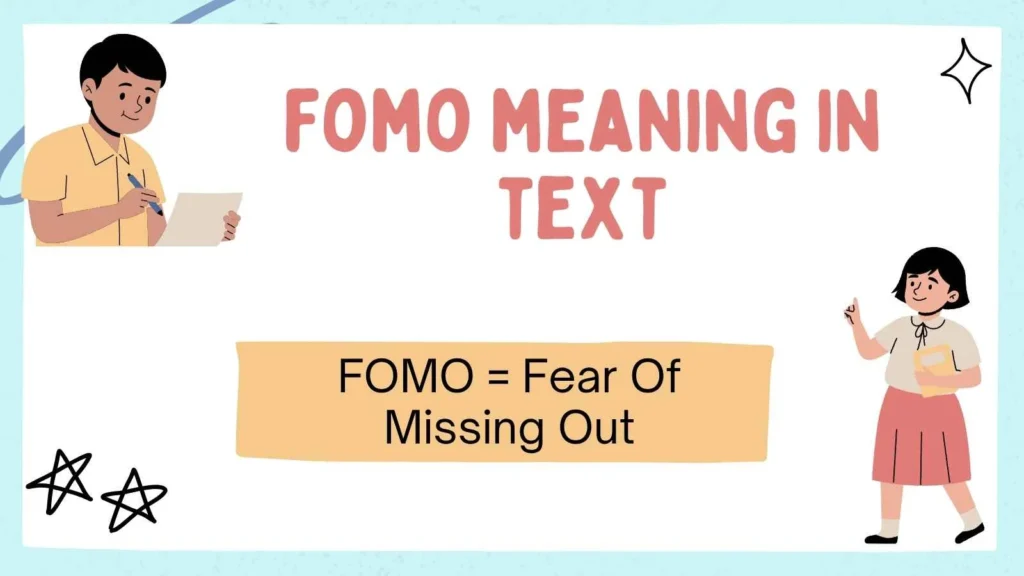
The FOMO meaning in text is Fear of Missing Out.
It describes the feeling that other people are enjoying exciting experiences without you. It can happen when you see friends hanging out, attending concerts, traveling, playing games together, or celebrating special moments while you’re not there.
Instead of writing the full phrase, people simply type FOMO because it’s short, easy, and widely understood online.
Simple Definition
FOMO = Fear Of Missing Out
It expresses feelings such as:
- 😟 Worry about being left out
- 📱 Anxiety after seeing social media posts
- 🎉 Wanting to join an event
- 👥 Feeling excluded from a group activity
- ❤️ Not wanting to miss memorable moments
Quick Meaning Table
| Term | Meaning |
|---|---|
| FOMO | Fear Of Missing Out |
| Type | Internet Slang |
| Used In | Text messages, chats, social media |
| Tone | Casual and emotional |
| Popular Among | Teens, adults, influencers, professionals |
Example Messages
Friend: We’re all going bowling tonight!
You: Now I have serious FOMO. 😭
Friend: Everyone went to the beach without me.
Reply: That’s real FOMO.
Instagram Caption
“Seeing everyone’s vacation pictures is giving me major FOMO. 🌴”
The phrase doesn’t always mean sadness. Sometimes people use it humorously to show they wish they were part of something fun.
The Origin of FOMO 📖
Although FOMO became popular because of social media, the feeling itself has existed for generations.
People have always worried about missing exciting experiences. Long before smartphones existed, individuals wondered whether they were missing important parties, celebrations, or opportunities.
However, the term Fear of Missing Out became widely recognized during the early 2000s as internet communication grew.
As platforms like Facebook, Twitter, Instagram, Snapchat, and TikTok became popular, users constantly saw updates about other people’s lives. This made the feeling even stronger because people could instantly compare themselves with friends and influencers.
Today, FOMO is recognized worldwide and appears in conversations across many cultures.
Timeline of FOMO
| Year | Development |
|---|---|
| Before Internet | Feeling existed but had no popular nickname |
| Early 2000s | “FOMO” started appearing online |
| Social Media Boom | Usage increased rapidly |
| Present Day | One of the world’s most recognized internet slang terms |
Today, millions of people use FOMO every day without thinking twice about its meaning.
Why Is FOMO So Popular in Text Messages? 📲
One reason the FOMO meaning in text has become so popular is convenience.
Modern conversations happen quickly. People prefer short abbreviations instead of long sentences.
Instead of typing:
“I feel like I’m missing all the fun.”
They simply write:
FOMO 😭
It’s faster while expressing the same emotion.
Reasons People Use FOMO
*✅ Short and easy
✅ Easy to understand
*✅ Popular on every major platform
✅ Expresses emotions quickly
*✅ Fits naturally into casual conversations
People often combine FOMO with emojis to make the feeling clearer.
Examples include:
- 😭 FOMO
- 😩 Major FOMO
- 😂 Weekend FOMO
- 😅 Vacation FOMO
- ❤️ Concert FOMO
These combinations make conversations more expressive.
How Is FOMO Used in Everyday Conversations? 🗨️
The FOMO meaning in text can change slightly depending on the situation, but the overall idea stays the same.
People use it whenever they wish they were participating in something exciting.
Example 1
Emma: We’re watching the new movie tonight.
Liam: Stop! You’re giving me FOMO.
Example 2
Alex: Everyone is playing online tonight.
Chris: I can’t join. Huge FOMO already.
Example 3
Sara: The concert looks amazing!
Mia: I’m feeling major FOMO.
Example 4
Jake: Our office trip was unforgettable.
Noah: Thanks for the FOMO. 😂
Notice that FOMO often appears as a complete reaction rather than part of a long sentence.
Different Situations Where People Use FOMO 🌍
One reason FOMO remains popular is that it fits almost every part of modern life.
Here are some common situations.
🎉 Parties
“My friends are celebrating without me.
FOMO is real.“
✈️ Travel
“Everyone is posting vacation photos.
I’ve got serious FOMO.”
🎵 Concerts
“I couldn’t get tickets.
Major FOMO today.”
🎮 Gaming
“The whole team is online.
I’m stuck studying.
FOMO!“
🎓 School Events
“My classmates are enjoying prom.
I’m experiencing FOMO.”
💼 Workplace
“The team attended an important conference.
I definitely have FOMO.”
🍕 Family Gatherings
“Everyone met at Grandma’s house.
I missed dinner.
Now I have FOMO.”
This flexibility explains why people of different ages use the term every day.
FOMO Meaning Across Different Social Media Platforms 📱
Although the meaning stays the same, the way people use FOMO can vary from one platform to another.
Here’s a quick overview.
| Platform | How FOMO Is Commonly Used |
|---|---|
| Vacation photos, parties, travel stories | |
| TikTok | Trending challenges, viral events |
| Snapchat | Friends hanging out without you |
| Family and group chats | |
| Life updates and celebrations | |
| X (Twitter) | Live events and breaking trends |
| Discord | Gaming sessions and online communities |
No matter where you see it, the FOMO meaning in text almost always refers to feeling left out of an enjoyable experience.
Common Examples of FOMO in Text Messages 💬
Below are realistic conversations that show how naturally people use FOMO.
Friends
Olivia: We all went hiking this morning.
Sophia: You didn’t invite me!
Major FOMO.
Family
Dad: We had your favorite dessert.
Son: You’re giving me FOMO.
School
Student 1: Everyone is at the football game.
Student 2: I wish I could go.
I’m feeling FOMO.
Work
Coworker: The team lunch was amazing.
Employee: Great…
Now I have FOMO. 😂
Travel
Friend: Paris is beautiful this time of year.
You: My travel FOMO is getting worse.
These examples show that FOMO works naturally in many different conversations without sounding forced.
Positive and Negative Sides of FOMO ⚖️
The FOMO meaning in text usually sounds lighthearted, but the feeling behind it can be both positive and negative.
Positive Effects 😊
- Encourages people to join fun activities.
- Inspires new experiences.
- Helps strengthen friendships.
- Motivates people to explore new places.
- Creates excitement about upcoming events.
Negative Effects 😟
- Can increase stress or anxiety.
- May lead to unhealthy comparisons.
- Causes unnecessary pressure to stay online.
- Makes people feel excluded.
- Can reduce satisfaction with everyday life.
The key is balance. It’s perfectly normal to experience FOMO occasionally, but it’s also important to enjoy your own experiences without constantly comparing yourself to others.
FOMO vs Similar Internet Slang Terms 🔄
The FOMO meaning in text is unique, but people often confuse it with other popular internet slang. Knowing the difference helps you use each term correctly.
| Slang | Full Form | Meaning | Example |
|---|---|---|---|
| FOMO | Fear Of Missing Out | Feeling left out of something fun | “I have FOMO after seeing your vacation photos.” |
| YOLO | You Only Live Once | Encourages taking chances | “Book the trip. YOLO!” |
| JOMO | Joy Of Missing Out | Enjoying staying home instead of going out | “I’m skipping the party. JOMO!” |
| OMO | Out Of the Loop | Not knowing what’s happening | “I’ve been offline all day. OMO.” |
| OMO (Alternate Use) | Fear of Missing Updates | Missing news or trends | “I checked my phone because of OMO.” |
Understanding the Difference
Imagine your friends are going camping.
- If you feel sad because you aren’t going, that’s FOMO.
- If you decide to stay home happily and relax, that’s JOMO.
- If you encourage everyone to enjoy life and take the trip, that’s YOLO.
Each abbreviation has its own meaning, even though they sometimes appear in similar conversations.
When Should You Use FOMO in Text? ⏰
The FOMO meaning in text fits best in casual conversations. It works naturally when you’re talking with friends, classmates, family members, or coworkers in an informal setting.
Great Times to Use FOMO
*✅ When friends attend an event without you
✅ After seeing exciting social media posts
*✅ During conversations about vacations
✅ When everyone watches a new movie except you
*✅ During gaming sessions you missed
✅ While chatting about concerts or sports events
Situations Where FOMO Fits Perfectly
- Group chats
- WhatsApp conversations
- Snapchat messages
- Instagram comments
- TikTok replies
- Facebook posts
- Discord chats
- Casual work chats
Situations Where You Should Avoid It
Although FOMO is common online, it may not suit every conversation.
Avoid using it in:
- Formal business emails
- Academic research papers
- Legal documents
- Professional reports
- Official announcements
In formal writing, it’s usually better to write “fear of missing out” instead of the abbreviation.
Common Mistakes People Make with FOMO ❌
Many people understand the FOMO meaning in text, but they still make small mistakes when using it.
Mistake 1: Thinking It Only Means Social Media
Wrong Idea: FOMO only happens on Instagram.
Correct: It can happen anywhere, including school, work, family gatherings, sports events, or vacations.
Mistake 2: Writing the Wrong Full Form
Some people accidentally invent different meanings.
Correct Full Form:
Fear Of Missing Out
Nothing else.
Mistake 3: Using It in Serious Professional Writing
Example:
❌ “The company experienced FOMO during the meeting.”
Instead, write:
✅ “The team was concerned about missing important discussions.”
Mistake 4: Confusing It with Jealousy
FOMO and jealousy are not exactly the same.
- Jealousy means wanting what someone else has.
- FOMO means wishing you were included in the experience.
Mistake 5: Overusing the Word
If every message says “FOMO,” it starts to lose its impact.
Use it naturally and only when it genuinely matches the situation.
Real-Life Examples of FOMO Meaning in Text 🌎
Let’s explore realistic situations where the FOMO meaning in text appears naturally.
Example 1: Birthday Party 🎂
Emma: We had so much fun at Olivia’s birthday party!
Lucas: I couldn’t come because I was traveling.
I’ve got serious FOMO.
Example 2: School Trip 🚌
Teacher: The museum visit was fantastic.
Student: Everyone keeps talking about it.
Now I have FOMO.
Example 3: Concert 🎤
Friend: The concert was incredible!
You: Stop posting videos.
You’re giving me FOMO.
Example 4: Weekend Getaway ✈️
Family Group Chat
Mom: We spent the weekend at the beach.
You: Those pictures are amazing.
Major FOMO!
Example 5: Gaming Night 🎮
Friend: We finally beat the boss.
You: I missed everything.
Huge FOMO today.
Example 6: Office Lunch 🍕
Coworker: Everyone loved the team lunch.
You: Next time invite me.
I’m feeling FOMO already.
These examples show that FOMO works naturally across different age groups and situations.
Why Understanding FOMO Matters Today 🌟
The internet has changed how people communicate. Every day, millions of photos, videos, and updates appear online. As a result, the FOMO meaning in text has become more relevant than ever.
Understanding this term helps you:
- Communicate more naturally in online conversations.
- Understand modern internet slang without confusion.
- Recognize emotions behind text messages.
- Connect better with younger audiences.
- Use social media language confidently.
It also reminds us that what we see online is only a small part of someone’s life. Most people share their happiest moments, not every ordinary day.
Knowing this can help reduce unnecessary comparisons and make your online experience healthier.
“You don’t have to be everywhere to enjoy life. Your own experiences matter too.” 💙
FOMO meaning in social media
- 📱 Discover what FOMO really means and why everyone uses it on social media.
- 🔥 Learn how FOMO creates excitement and keeps people scrolling for hours.
- 👀 See why missing trending posts can trigger serious Fear of Missing Out.
- 💬 Find out how influencers use FOMO to boost likes, comments, and shares.
- 📸 Explore real FOMO examples from Instagram, TikTok, Snapchat, and Facebook.
- 🚀 Understand why limited-time posts make users act faster than ever.
- ❤️ Learn how FOMO affects emotions, online habits, and digital friendships.
- 🎯 Spot common FOMO phrases used in captions, stories, and viral posts.
- ⚡ Discover the psychology behind FOMO and why it feels so powerful.
- 🌍 See how FOMO shapes online trends across different social media platforms.
- 📈 Learn smart ways to manage FOMO while still enjoying social media.
- 💡 Master the meaning of FOMO so you never feel confused by online conversations.
FOMO abbreviation meaning
- 📝 Learn the full form of FOMO in seconds without any confusion.
- 💡 Discover why FOMO stands for Fear of Missing Out and what it means.
- 📚 Understand the origin of the FOMO abbreviation and how it became popular.
- 💬 See how people use FOMO naturally in texting, chats, and social media.
- 🔍 Explore simple examples that make the FOMO abbreviation easy to remember.
- 📱 Find out where the FOMO acronym appears most often online.
- 🚀 Learn when using FOMO sounds natural and when it does not.
- 👥 Discover how different age groups use the FOMO abbreviation in daily conversations.
- 🌐 Compare FOMO with other popular internet abbreviations to avoid confusion.
- 🎯 Understand the hidden emotions behind the FOMO abbreviation.
- ⚠️ Avoid common mistakes people make when using FOMO in messages.
- ✅ Become confident using the FOMO abbreviation in everyday online communication.
FAQs:
What does FOMO mean in text messages?
FOMO stands for Fear Of Missing Out. It describes the feeling of wishing you were part of an event, activity, or experience that others are enjoying.
Is FOMO a positive or negative word?
It can be both. Sometimes people use FOMO jokingly, while other times it describes genuine feelings of disappointment or anxiety about missing something exciting.
Is FOMO only used on social media?
No. Although social media made the term popular, people also use FOMO in text messages, workplace chats, family conversations, gaming communities, and everyday discussions.
Can adults use FOMO?
Absolutely. People of all ages use FOMO. Teenagers, college students, professionals, parents, and even businesses may use the term in casual conversations.
Is FOMO considered internet slang?
Yes. FOMO is one of the most recognized internet slang abbreviations used in digital communication around the world.
Final Thoughts:
Understanding the FOMO meaning in text helps you communicate more naturally in today’s digital world.
Like many modern abbreviations, FOMO saves time while expressing a relatable emotion. It can describe everything from missing a concert or vacation to feeling left out of a group activity or online trend.
While it’s perfectly normal to experience FOMO occasionally, it’s also important to remember that everyone misses out on something now and then.
The next time someone texts, “I’m having major FOMO,” you’ll know exactly what they mean and how to respond confidently.

I am a dedicated SEO content writer and language enthusiast with a passion for making modern slang, text abbreviations, and internet terms easy to understand. I carefully research every topic using trusted sources and real-world usage to ensure each explanation is accurate, clear, and up to date. My goal is to help readers quickly understand confusing words, texting acronyms, and online expressions through simple English, practical examples, and easy-to-follow guides. Every article is written with a focus on quality, trustworthiness, and a great reader experience, so you can find reliable answers with confidence.